BACK
Habitopia - Designing a habit system that helps people become who they want to be.
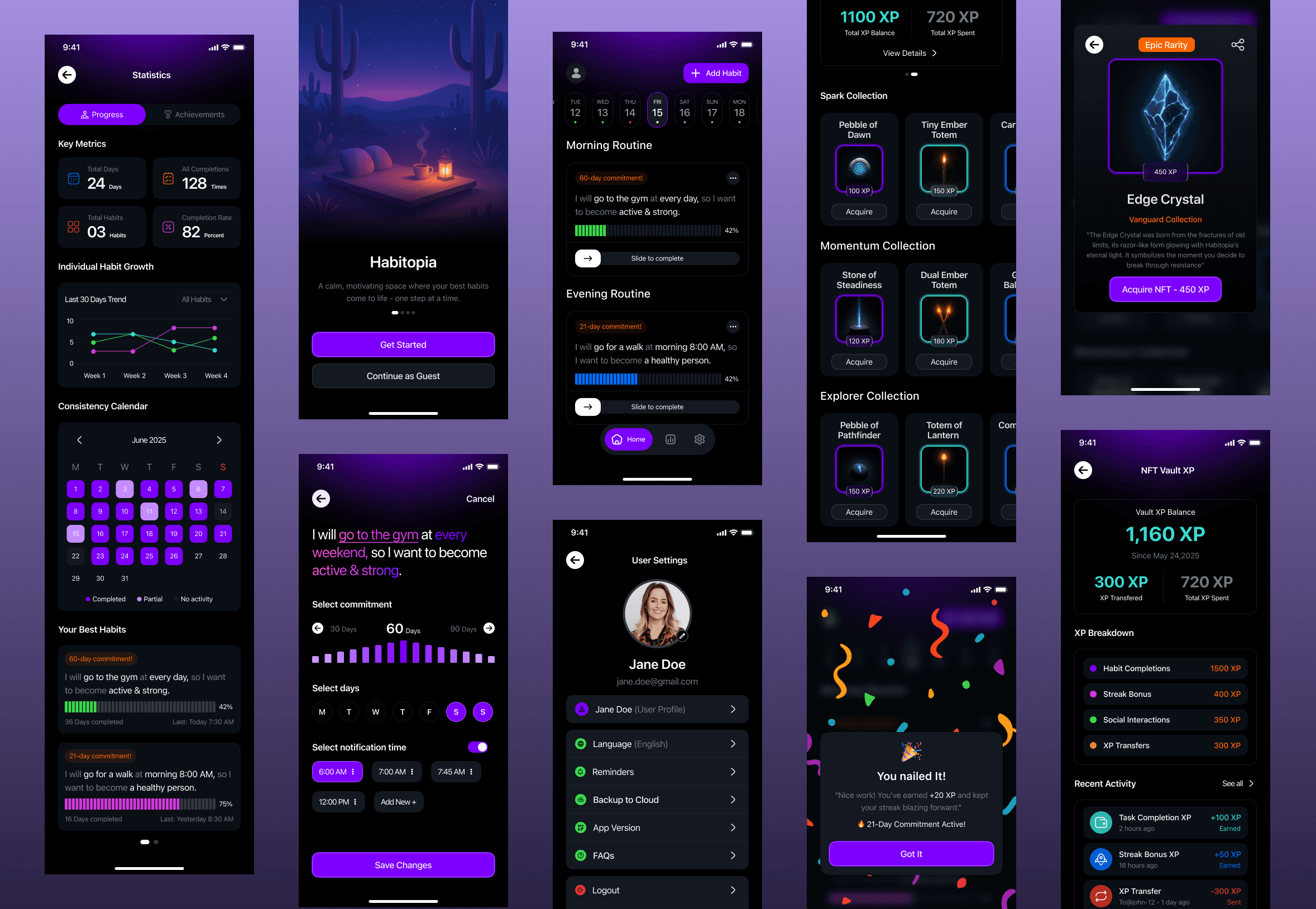
The quiet failure no one talks about
The illusion of a strong start
Every year, people decide to change their lives. They commit to waking up earlier, exercising regularly, reading more, and becoming more disciplined. The beginning feels powerful - full of clarity, motivation, and control. For a while, everything works. Progress feels visible. Momentum builds. It feels like this time might finally be different.
The pattern no one designs for
But then, almost quietly, something begins to shift.
A single day is missed. It doesn’t seem significant at first. But that small break introduces friction. The next day feels slightly harder. The routine that once felt energising now feels like effort. That effort builds resistance. And over time, that resistance turns into guilt.
What started as excitement gradually becomes a cycle:
excitement → friction → guilt → abandonment
People don’t fail to start habits. They fail to continue them.
Where existing solutions fall short
Yet most habit trackers are not designed for this reality. They rely on repetition, consistency, and streaks, assuming motivation will remain stable. Progress is reduced to checkmarks, and success is measured by how long a streak lasts. But behaviour is not linear.
Most tools track actions, not transformation. They capture what users do, but not what those actions mean. And when the streak breaks, the system often reinforces failure instead of supporting recovery.
A different way to think about habits
The problem isn’t discipline - it’s misalignment. Habit building is about identity. People sustain habits when their actions reflect who they’re becoming. When that connection exists, consistency feels natural.
Designing for who you’re becoming
This perspective reframes the role of a habit system entirely.
Instead of asking:
 “Did you complete your habit today?”
The better question becomes:
 “Are you becoming the person you intended to be?”
Habitopia was designed from this belief - not to track what you do, but to support who you’re becoming.
Project at a Glance - A system, not just an app
What is Habitopia
Habitopia is a behaviourally designed habit-building system focused on long-term consistency and identity transformation. Unlike traditional habit trackers that centre around daily completion and streaks, Habitopia explores a different approach - one that aligns with how people actually build and sustain habits over time.
At its core, the product is not just about tracking actions. It is about helping users stay connected to who they are trying to become, even when motivation fluctuates.
My Role
Product Designer
Scope
Research and behavioural analysisUX strategy and concept developmentUser flows and interaction designWireframes and high-fidelity UI
Prototyping and iteration
Timeline
1 Months
Project Type
Self-initiated concept
Outcome
Designed a habit system that shifts focus from task completion to personal transformation, helping users stay engaged and build consistent behaviours over time.
Full Project
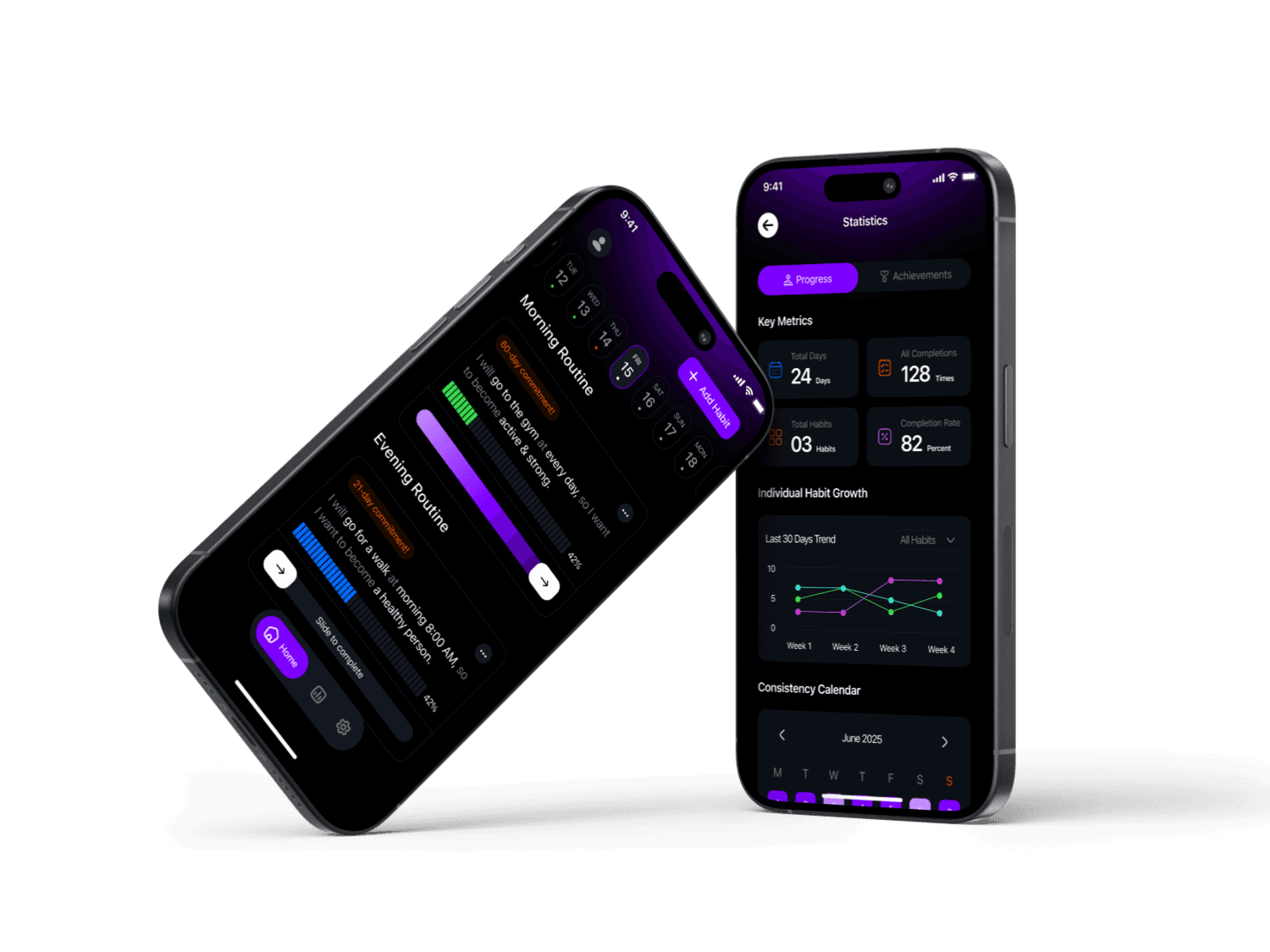
The Uncomfortable Truth - Why habits actually fail
Motivation was never meant to last
Most habit systems are built on a flawed assumption - that motivation is stable.
In reality, motivation is temporary. It fluctuates based on energy, mood, environment, and countless external factors. Yet, most habit trackers are designed as if users will show up with the same level of intent every single day. When that doesn’t happen, the system begins to break - not because the user failed, but because the design expected consistency that doesn’t exist.
When streaks become pressure
Streaks are often positioned as a source of motivation. In the early stages, they work. They create momentum and a sense of progress. But over time, they introduce a different kind of pressure.
The longer the streak, the higher the stakes.
Missing a single day doesn’t just mean a small gap - it feels like losing everything. This all-or-nothing dynamic turns habits into fragile systems. Instead of encouraging continuation, streaks often amplify the emotional cost of failure, making it harder for users to return once they fall off.
Progress that feels invisible
Another underlying issue is how progress is perceived.
Most systems measure success through daily completion. But habit-building is not about isolated actions - it’s about cumulative change over time. When users miss a day, the system reflects zero progress, even though the effort from previous days still matters.
This creates a disconnect. Users feel like they are starting from scratch, even when they’re not.
Repetition without meaning
Over time, habits can lose their emotional connection.
What begins with intention gradually becomes routine. Users check off tasks without reflecting on why they started. The process becomes mechanical - something to complete rather than something to care about.
Without meaning, repetition leads to boredom. And boredom leads to disengagement.
The real problem
Habits don’t fail because people lack discipline.
They fail because the systems designed to support them don’t align with human behaviour.
They don’t account for inconsistency.They don’t make progress feel real.And most importantly, they don’t reinforce identity.
This is where Habitopia begins - by designing for how people actually behave, not how they’re expected to behave.
Reframing the Problem - From tracking actions to shaping identity
Shifting the lens
Once the core issues became clear, the problem itself needed to be reframed.
Traditional habit trackers ask a simple question: “Did you complete your habit today?”
 While useful on the surface, this framing reduces behaviour to isolated actions. It focuses on short-term completion rather than long-term change.
Habitopia shifts this perspective entirely. Instead of measuring what users do, the focus moves toward what those actions represent. The question is no longer about daily completion, but about continuity of intent - whether users are still aligned with the version of themselves they set out to become.
From tasks to identity
This shift introduces a fundamentally different way of thinking about habits.
Habits are not just repeated actions. They are signals of identity.
When users say, “I want to work out,” they are often expressing something deeper - “I want to become healthy and disciplined.” The action is only a small part of a larger transformation.
By anchoring habits to identity, the system creates a stronger sense of meaning. Actions are no longer tasks to complete, but steps toward becoming.
Designing for real behaviour
This reframing led to a set of guiding principles.
The system should support users even when motivation drops.Progress should feel continuous, not reset by small breaks.Missing a day should not feel like failure.And most importantly, the experience should reinforce identity over time.
A new foundation
Habitopia is built on this belief - that lasting habits are not formed through pressure or perfection, but through alignment.
Not just helping users act consistently, but helping them stay connected to who they are becoming.
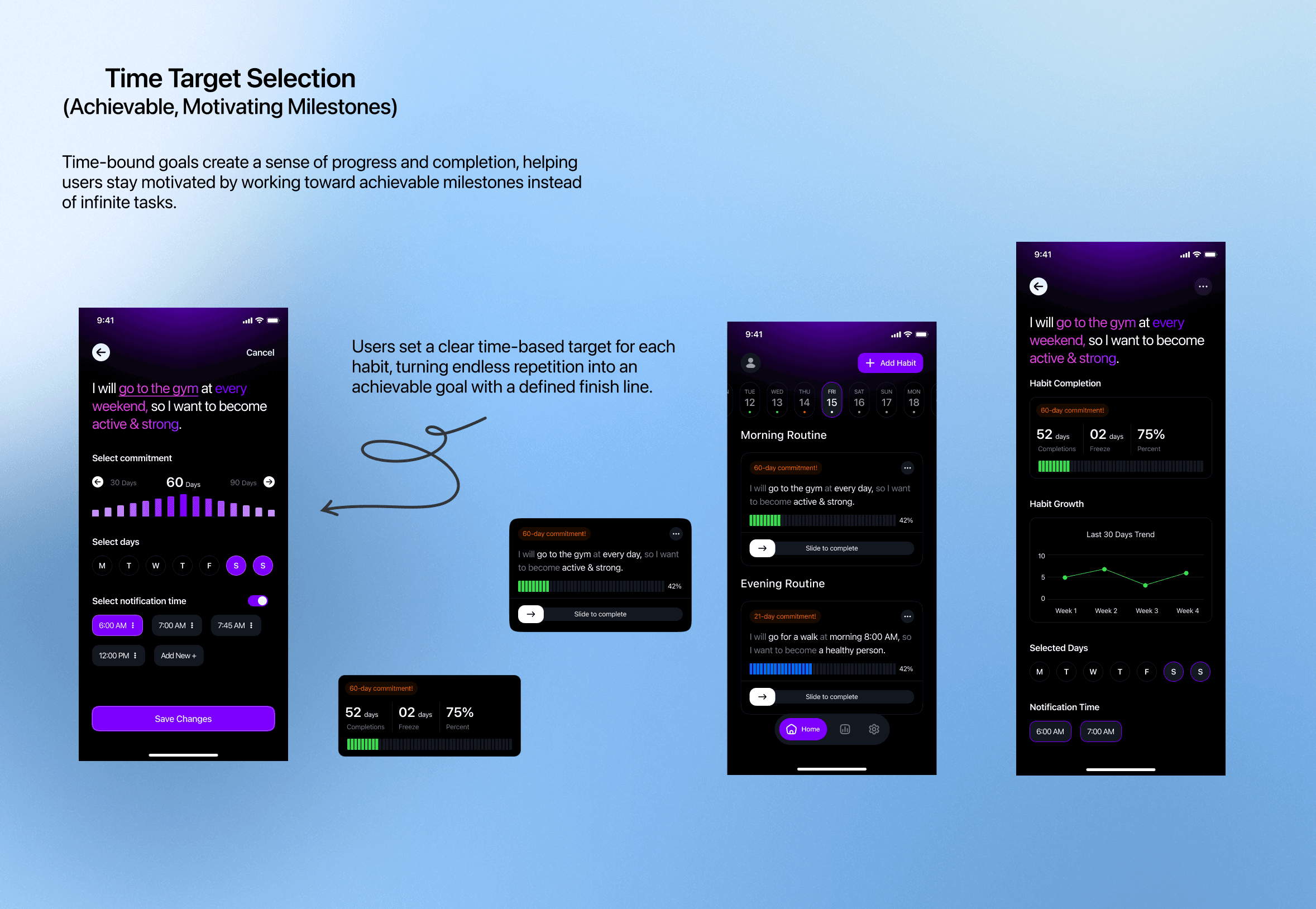
Designing the System - From habit tracker to behaviour system
Thinking beyond a tracker
With the problem reframed around identity and continuity, the solution could no longer be a traditional habit tracker.
Habitopia was designed as a behaviour system, not a task manager. The focus shifted from logging daily actions to supporting a longer journey - one where users could stay engaged even when consistency wasn’t perfect. Instead of optimising for short-term completion, the system prioritises long-term commitment.
This meant designing not just for moments of motivation, but for moments of resistance.
Designing for the full journey
Most habit products are built around ideal scenarios - when users are focused, disciplined, and ready to act. Habitopia takes a different approach by considering the full emotional spectrum of behaviour.
The system acknowledges that users will feel motivated some days, indifferent on others, and resistant at times. Rather than breaking under these fluctuations, the experience is designed to absorb them.
Consistency is no longer defined as “never missing a day,” but as always returning.
Three foundational pillars
This approach is grounded in three key ideas that shape the entire experience.
This approach is grounded in three key ideas that shape the entire experience.
Identity-first habit creation
 Habits begin with defining who the user wants to become. This anchors actions in meaning, making them feel purposeful rather than repetitive.
Milestone-based progress
Instead of endless streaks, progress is structured into meaningful checkpoints. This allows users to see growth over time without the pressure of maintaining perfection.Flexible consistency
The system is designed to tolerate breaks. Missing a day does not reset progress, but simply becomes part of the journey. Users are encouraged to continue, not restart.
A system that adapts to people
By combining these principles, Habitopia moves away from rigid tracking and toward adaptive support.
The goal is not to enforce discipline, but to create a system that works with human behaviour - one that guides, supports, and evolves alongside the user.
Translating Strategy into Experience - From principles to product
Designing the experience, not just the interface
With a clear behavioural foundation in place, the next step was translating these principles into a product experience that feels intuitive, supportive, and lightweight.
Rather than introducing complex systems or heavy interfaces, the focus was on reducing friction and guiding users through a journey that feels natural. Every interaction was designed to reinforce continuity, clarity, and a sense of progress - without overwhelming the user.
The goal was simple: make the right behaviour feel easy to return to.
Habit creation - Turning intention into commitment
When creating a habit, users are not just defining what they will do, but how it connects to their identity.
The experience avoids rigid structures like “every day without fail.” Instead, it introduces flexible frequency, allowing users to commit in a way that feels realistic. This reduces pressure while maintaining clarity.
Each habit becomes a reflection of intent, not just a recurring task.
Progress system - Making growth visible
One of the key shifts in Habitopia is how progress is represented.
Instead of streaks, the system focuses on milestone-based progression. Users see how their efforts accumulate over time, rather than being judged on daily perfection. Even with gaps, progress continues to feel intact.
This creates a sense of momentum without the fear of losing everything.
Daily interaction - Reducing friction
Daily engagement is designed to be lightweight and focused.
Users can quickly check in, mark progress, and move on without navigating complex dashboards or unnecessary data. The interface prioritises clarity over features, ensuring that interaction feels effortless even on low-motivation days.
The system supports action without demanding attention.
Recovery experience - Designing for imperfection
A defining part of Habitopia is how it handles inconsistency.
Missing a day does not trigger a reset or penalty. Instead, the system encourages continuation. Language, feedback, and interaction patterns are intentionally designed to feel supportive rather than corrective.
This transforms failure from a breaking point into a natural part of the journey.
An experience that stays with the user
Across every touchpoint, the experience is designed to reinforce one idea - progress is not about perfection, but persistence.
By aligning interactions with real human behaviour, Habitopia creates a system that users can return to, even after they drift away.
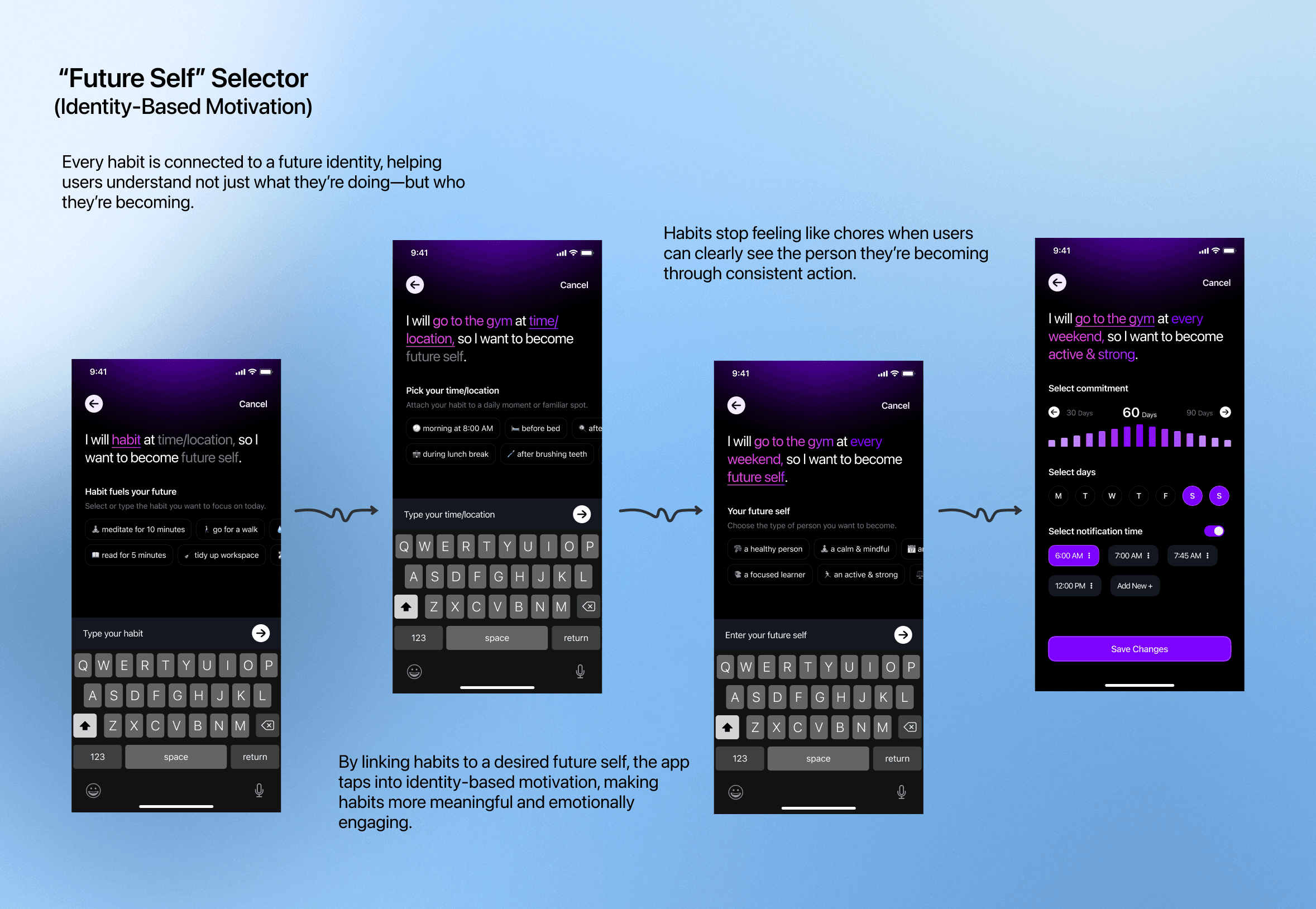
The Thinking Behind Habitopia - Designing beyond conventional habit systems
Habitopia was not designed by adding features to an existing pattern. It was shaped by questioning those patterns entirely.
Most habit products optimise for engagement through familiar mechanics - streaks, reminders, rewards. But over time, these systems often create pressure, lose meaning, or fail to sustain long-term behaviour. This chapter outlines the key decisions that guided Habitopia, each rooted in a simple goal: design for how people actually behave, not how they are expected to behave.
Rethinking consistency - From streaks to commitment cycles
Streaks are powerful in the beginning. They create momentum, structure, and a sense of progress. But as the streak grows, so does the pressure to maintain it. A single missed day can feel like losing everything, often leading to complete disengagement.
Instead of reinforcing this fragile system, Habitopia replaces streaks with commitment cycles.
Each habit is structured within a defined duration, with a clear start and end. This creates a sense of direction and, more importantly, completion. Rather than maintaining an infinite chain, users move through cycles - similar to how people naturally pursue goals in real life.
This shift reduces the fear of breaking progress and introduces a healthier form of consistency: one that allows users to pause, but still return.
Designing for identity - Moving beyond task completion
Traditional habit trackers focus on a simple question: “Did you complete your task today?” While functional, this reduces behaviour to a binary outcome.
Habitopia reframes this entirely.
The focus shifts to a deeper question: “Are you becoming who you intended to be?”
This changes how users relate to their habits. Actions are no longer isolated tasks, but signals of identity. Over time, this creates a stronger emotional connection. Users are not just completing habits - they are reinforcing a version of themselves.
And when behaviour is tied to identity, consistency becomes more natural than forced.
Rethinking rewards - From incentives to ownership
Rewards in most habit systems are designed to incentivise action. But when rewards are easy to earn and endlessly repeatable, they quickly lose meaning.
Habitopia explores a different direction.
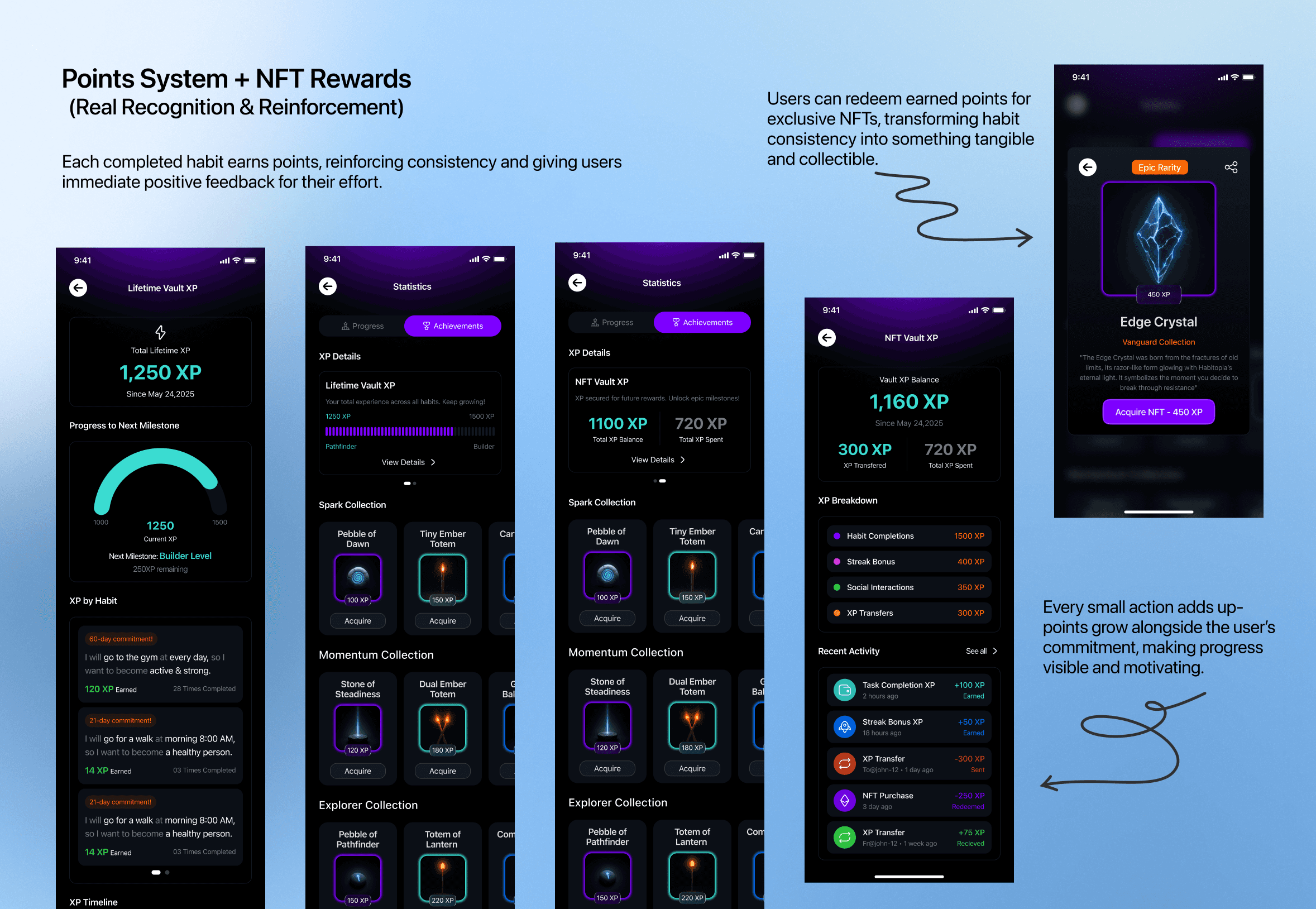
Rewards are treated as collectable achievements - representations of effort, progress, and milestones. They are designed to feel earned, not given. The intention is to create emotional value, not just momentary satisfaction.
To support this idea, I explored NFT-based rewards as a mechanism for ownership. Not as a trend-driven addition, but as a way to give users something that feels truly theirs - something that persists beyond the moment of completion.
Because at its core, the idea is simple:
People value what they feel they own.
A system designed for humans
These decisions are not isolated features. They are interconnected parts of a larger system.
Commitment cycles reduce pressure.Identity creates meaning.Ownership reinforces value.
Together, they shape an experience that moves beyond tracking behaviour, toward supporting transformation.
Habitopia is not designed to make users perfectly consistent.
It is designed to help them stay long enough to become someone new.
Reflection - What this project taught me
Designing for behaviour, not just features
Habitopia fundamentally changed how I approach product design.
Before this project, it was easy to think in terms of features - what users can do, what screens are needed, what interactions make sense. But working on Habitopia shifted that perspective toward behaviour. It highlighted that designing a feature is not the same as designing an outcome.
A habit tracker is not valuable because it logs actions. It’s valuable if it helps users stay consistent over time. That distinction pushed me to think beyond interfaces and focus on how design influences real-world behaviour.
The importance of emotional design
One of the most important learnings was recognising how deeply emotions shape user behaviour.
Friction is not always functional - it is often emotional. Guilt, pressure, and overwhelm can quietly break an experience, even if the interface itself is well designed. Habitopia required designing for these emotional states, not just user flows.
This meant being intentional about tone, feedback, and how the system responds when users fall off - not just when they succeed.
From systems thinking to product thinking
This project reinforced the importance of systems thinking.
Instead of designing isolated screens, I had to think about how each part of the experience connects - how onboarding influences commitment, how progress affects motivation, and how recovery impacts long-term retention.
Every decision had ripple effects across the system.
What I would explore next
If I were to take Habitopia further, I would explore making the system more adaptive.
There is an opportunity to personalise the experience based on user behaviour - adjusting goals, nudges, and feedback dynamically.
Integrating lightweight intelligence could help the system respond more intelligently to motivation patterns and engagement levels.
A shift in perspective
Habitopia was more than a design project.
It was a shift in how I think about products - from building tools that people use, to designing systems that people can grow with.
Closing - Designing for who people become
Beyond habits, toward transformation
Habitopia was never intended to be just another habit tracker.
It was an exploration into how products can support people through change - not just by helping them act, but by helping them stay. In a space filled with tools that measure consistency, this project focused on something more human: continuity, meaning, and identity.
Because in the end, habits are not the goal.
They are simply the mechanism.
A different measure of success
The real measure of success is not whether a user completes a task every day, but whether they return - again and again - long enough to become someone new.
Habitopia was designed with that belief at its core.
Not to push users toward perfection, but to support progress that feels real, sustainable, and personal.